Unified Software process (USP) is an architecture-centric, use-case driven, iterative and incremental development process that leverages unified modelling language and is compliant with system process engineering metamodel. Unified process can be applied to different software systems with different levels of technical and managerial complexity across various domains.
There are many different types of USP like OpenUP and Agile Unified Process but today we are going to focus on RUP:
Really
Underrated
Process
(It actually stands for Rational Unified Process but hey, it is much more fun spelling it that way!)

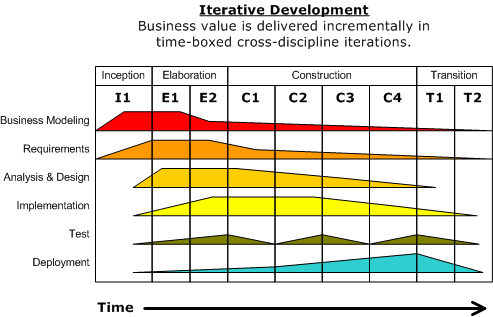
RUP is a system development process. RUP has its foundation in that the system is specially customized for a specific organization or client! On the surface, RUP occur pretty identical to Waterfall, but it actually has more differentiate than you think. For an example RUP is more of an iterative developmental approach and each of the stages includes constant feedback and time spent defining requirements.
A RUP-project can be divided into four different phases:
INCEPTION
This phase is about preparation and the idea for the project is started. The progress team analyse and decide if the project is worth pursuing, what resources will be need and to what cost. If the inception phase doesn’t get executed properly should the project manger either cancel the project or reconsider.
ELABORATION
This phase is the most important one. When this phase is fully completed the analyse and the design of the system will be done. The project’s architecture and appropriate resources are even further evaluated. As said, it is very important that the project is understood to the fullest otherwise you can’t start making decisions about the system architecture.
CONSTRUCTION
The software is being built and tested, the main goal is to develop components and important features of the system. When the construction phase is completed a decision will be taken if it is possible to release the system to the end users’ which will be the next phase.
TRANSITION
The software is now released to the public and everyone can just move on to something else

Okay not quite, it is still very important to listen to the end users’ feedback and do some final adjustment or updates.
REFERENCES
https://techterms.com/definition/rup
https://www.techopedia.com/definition/3885/unified-process-up

 Olles blog